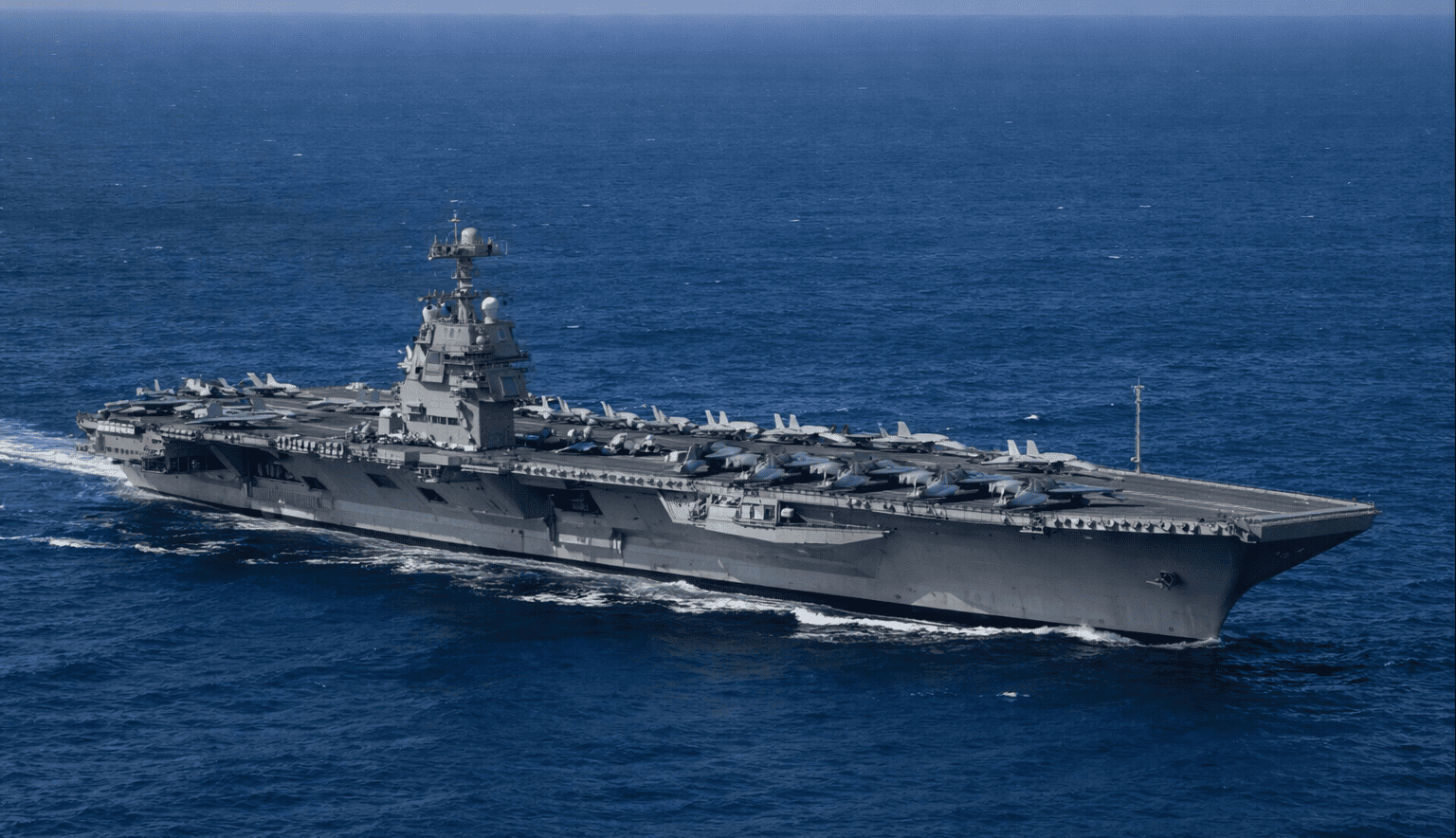
USS Gerald Ford (CVN-78)
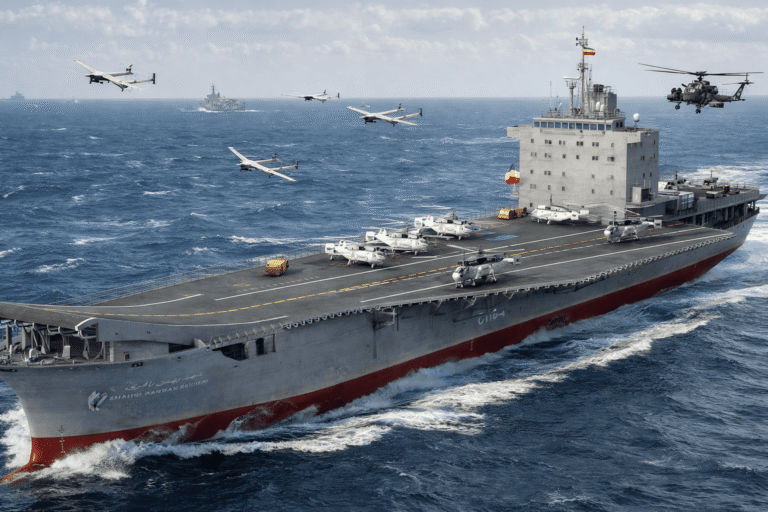
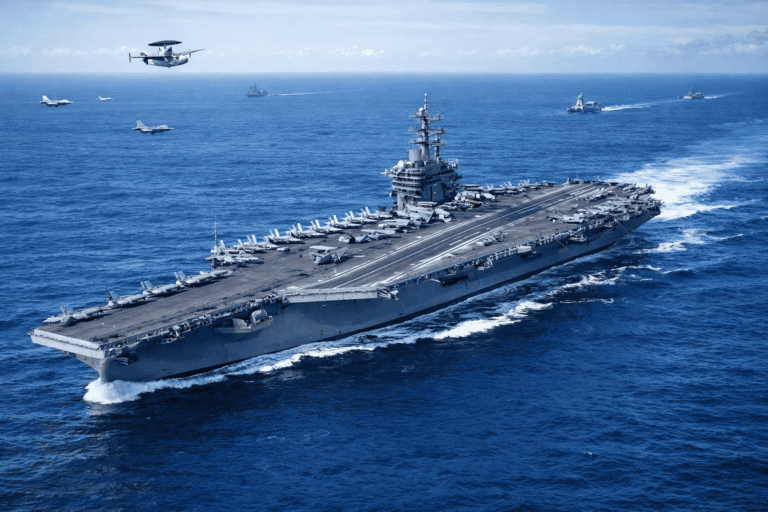
The USS Gerald Ford aircraft carrier is the most advanced and powerful warship ever built by the United States Navy. As the lead ship of the Ford-class carriers, it represents a new generation of naval warfare technology, energy systems, and aircraft launch capability.
In 2026, the USS Gerald Ford aircraft carrier has once again become a major headline topic due to rising tensions between the United States and Iran. Reports indicate that the carrier strike group is moving toward the Middle East region, drawing global attention.
This article provides complete professional details including:
- Latest 2026 deployment news
- Statements linked to Donald Trump
- Construction and builder information
- Size, speed, and nuclear power details
- Weapons and radar systems
- Past deployments
- Strategic importance in US-Iran tensions
Latest Middle East News : Middle East Deployment 2026
According to recent defense reports, the USS Gerald Ford aircraft carrier has been ordered to reinforce US naval presence in the Mediterranean and potentially the Persian Gulf.
In February 2026, crew members were informed that the carrier would join other US strike groups in the region amid escalating tensions. Defense analysts describe this as a strategic deterrence move rather than an offensive deployment.
The movement of the USS Gerald Ford aircraft carrier comes during a period of increased regional instability involving Iran, Israel, and US interests in the Middle East.
About USS Gerald Ford Aircraft Carrier
The USS Gerald Ford aircraft carrier (CVN-78) is the lead ship of the Ford-class carriers and the largest warship in the world.
Named After:
Former US President Gerald R. Ford
Builder:
Newport News Shipbuilding (Huntington Ingalls Industries)
Construction Timeline:
- Awarded: September 2008
- Keel Laid: November 2009
- Launched: October 2013
- Commissioned: July 22, 2017
- Home Port: Norfolk, Virginia
The USS Gerald Ford aircraft carrier replaced the historic USS Enterprise (CVN-65).
Aircraft Capacity & Aviation Facilities
- Aircraft Capacity: 75+ aircraft
- Flight Deck Size: 1,092 × 256 ft (333 × 78 m)
- Aircraft Launch System: EMALS (Electromagnetic Aircraft Launch System)
- Advanced Arresting Gear (AAG)
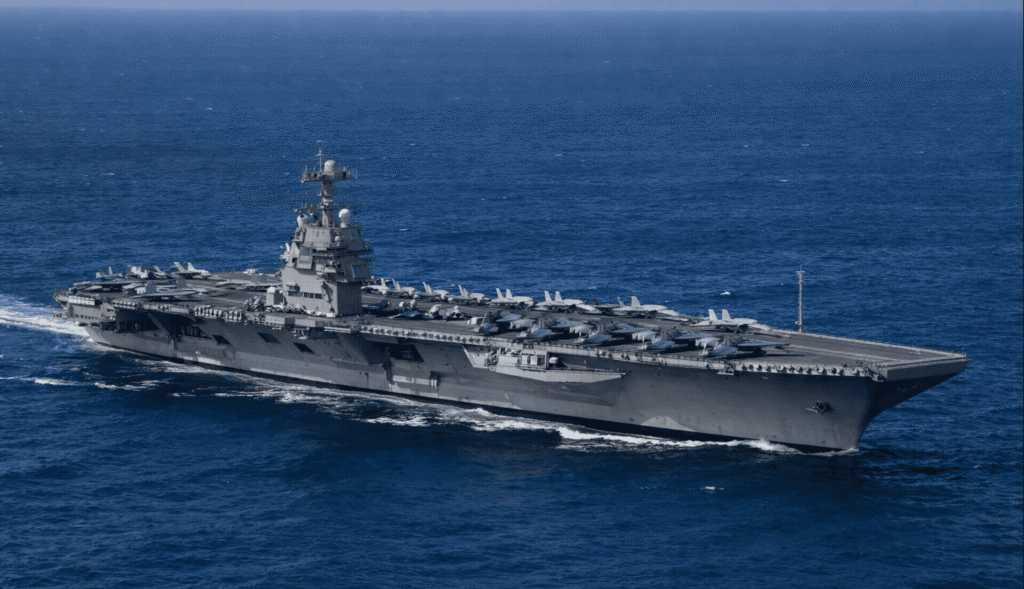
General Characteristics
- Class & Type: Gerald R. Ford-class aircraft carrier
- Hull Number: CVN-78
- Displacement: About 100,000 long tons (full load)
- Length: 1,106 ft (337 m)
- Beam (Waterline): 134 ft (41 m)
- Beam (Flight Deck): 256 ft (78 m)
- Height: 250 ft (76 m)
- Draft: 39 ft (12 m)
- Decks: 25
- Crew Complement: Approx. 4,539 personnel (including air wing)
.Power & Propulsion
- Installed Power: Two Bechtel A1B nuclear reactors
- Reactor Type: Pressurized Water Reactors (PWR)
- Propulsion: Four shafts
- Maximum Speed: In excess of 30 knots (56 km/h / 35 mph)
- Operational Range: Approximately 25 years before mid-life refueling
.Sensors & Radar Systems
S-band active electronically scanned array
AN/SPY-3 Multi-Function Radar (MFR)
X-band active electronically scanned array
AN/SPY-4 Volume Search Radar (VSR)
Armament & Defense Systems
Surface-to-Air Missiles:
- 2 × RIM-162 Evolved Sea Sparrow Missile (ESSM) launchers
- 2 × RIM-116 Rolling Airframe Missile (RAM) launchers
Close-In Defense:
- 3 × Phalanx CIWS (Close-In Weapon System)
- 4 × Mk 38 25 mm Machine Gun Systems
- 4 × M2 .50 caliber (12.7 mm) machine guns
Trump Announcement & Political Context
Former President Donald Trump previously commissioned the USS Gerald Ford aircraft carrier in 2017 and has publicly referenced it in speeches as a symbol of American military strength.
Recent political commentary suggested that the carrier was “heading toward Iran” as part of a broader US military readiness strategy. While official Pentagon statements describe the deployment as precautionary, political leaders have framed the USS Gerald Ford aircraft carrier as a visible show of naval power.
It is important to note that aircraft carriers are typically deployed for deterrence and strategic balance rather than immediate conflict.
Comparison of USS Gerald R. Ford (CVN-78) and USS Abraham Lincoln (CVN-72)
| Feature | USS Gerald R. Ford (CVN-78) | USS Abraham Lincoln (CVN-72) |
|---|---|---|
| Class | Gerald R. Ford-class | Nimitz-class |
| Commissioned | 22 July 2017 | 11 November 1989 |
| Displacement | ~100,000 tons | ~97,000 tons |
| Length | 1,106 ft (337 m) | 1,092 ft (333 m) |
| Beam | 256 ft (78 m) | 134 ft (41 m) (flight deck ~252 ft) |
| Speed | 30+ knots | 30+ knots |
| Propulsion | 2 × A1B nuclear reactors | 2 × A4W nuclear reactors |
| Aircraft Capacity | ~75+ (more efficient deck operations) | ~60–70 |
| Crew | ~2,600 (ship) + 2,480 (air wing) | ~3,200 (ship) + 2,480 (air wing) |
| Flight Deck | Advanced arresting gear, Electromagnetic Aircraft Launch System (EMALS) | Steam catapults |
| Tech Upgrades | Advanced radar (AN/SPY-3), automated systems, reduced maintenance | Older radar & systems, less automation |
| Cost | ~$13 billion | ~$4.5 billion (at time of construction) |
| Key Advantage | More advanced technology, faster sortie rate, reduced crew needs | Proven, reliable, battle-tested |
Summary and Key Details
- USS Gerald R. Ford (CVN-78) is the latest generation supercarrier with cutting-edge technology. Its EMALS catapults, advanced radar systems, and automated operations allow higher sortie rates, lower maintenance, and fewer crew requirements. It represents the future of U.S. Navy carriers.
- USS Abraham Lincoln (CVN-72) is a reliable Nimitz-class carrier with decades of operational experience. While it uses older technology like steam catapults and traditional radar systems, it has proven its effectiveness in real-world missions and remains a critical component of the U.S. Navy.
- Key Difference: Gerald R. Ford focuses on modernization and efficiency, whereas Abraham Lincoln emphasizes proven reliability and operational history.
Operational History Highlights
2022
In 2022, the USS Gerald Ford aircraft carrier participated in multiple NATO-led maritime exercises in the Atlantic Ocean and Mediterranean Sea. These exercises focused on joint naval operations, air defense coordination, and interoperability between allied forces.
The deployment marked an important step in demonstrating the operational readiness of the Ford-class carrier in multinational environments.
2023
In 2023, the USS Gerald Ford aircraft carrier was deployed to the Eastern Mediterranean following heightened regional tensions after the Hamas–Israel conflict.
The carrier strike group’s presence was described by U.S. defense officials as a deterrence measure aimed at maintaining regional stability and supporting allied security commitments. The deployment showcased the ship’s advanced aviation systems and rapid-response capability.
2024
During 2024, the USS Gerald Ford aircraft carrier completed an extensive eight-month deployment, traveling more than 83,000 nautical miles.
The mission included maritime security operations, joint exercises with partner nations, and sustained flight operations to test sortie generation capabilities. The deployment demonstrated improved operational efficiency compared to previous carrier classes.
2025
In 2025, the USS Gerald Ford aircraft carrier conducted operations in the Mediterranean and North Sea regions, strengthening cooperation with European allies.
Later in the year, the carrier redeployed to the Caribbean for maritime presence missions and regional security engagements, reflecting its flexible global deployment capability.
2026
In 2026, the USS Gerald Ford aircraft carrier is planned to support additional U.S. carrier strike group operations in the Persian Gulf amid rising diplomatic and regional tensions involving Iran.
The deployment is viewed as a strategic positioning move designed to reinforce naval readiness and ensure rapid response capability in a sensitive geopolitical environment.
Why USS Gerald Ford Aircraft Carrier Is Important
- Most expensive warship ever built
- Most advanced launch system (EMALS)
- Reduced crew, higher efficiency
- Designed for 50-year service life
- Symbol of US naval dominance
The USS Gerald Ford aircraft carrier represents next-generation naval warfare capability.
Cost & Investment
- Construction cost: Approx. $13+ billion
- Research & development: $4.7 billion
- Total program cost significantly higher due to advanced technology upgrades
Despite early technical challenges, the carrier achieved operational capability and continues upgrades.
USS Gerald Ford – Frequently Asked Questions (FAQ)
Q1: Where is USS Gerald Ford currently located?
A: USS Gerald Ford (CVN-78) is primarily based at Naval Station Norfolk, Virginia, USA. It may also be deployed to the Atlantic Ocean, Mediterranean Sea, or other regions as part of U.S. Navy operations.
Q2: What is the size of USS Gerald Ford?
A: USS Gerald Ford is approximately 1,106 feet (337 meters) long, with a beam of 256 feet (78 meters), and a displacement of about 100,000 tons, making it the largest aircraft carrier in the U.S. Navy.
Q4: How many aircraft can USS Gerald Ford carry?
A: The carrier can accommodate around 75+ aircraft, including fighter jets, helicopters, and unmanned aerial vehicles, with more efficient deck operations than previous carriers.
Q5: What makes USS Gerald Ford different from other carriers?
A: It features EMALS catapults for launching aircraft, advanced radar (AN/SPY-3), automated systems, and reduced crew requirements, allowing for faster sorties and lower maintenance.
Q6: When was USS Gerald Ford commissioned?
A: The ship was officially commissioned on 22 July 2017.
Q7: What is the cost of USS Gerald Ford?
A: The construction cost is estimated at $13 billion, making it the most expensive aircraft carrier ever built.
Q8: How does USS Gerald Ford compare to USS Abraham Lincoln?
A: Gerald Ford is newer, more automated, and technologically advanced, with EMALS catapults and better sortie rates. Abraham Lincoln (CVN-72), a Nimitz-class carrier, is proven, reliable, and battle-tested but uses older steam catapults and systems.
Q9: What is the crew size of USS Gerald Ford?
A: The ship requires about 2,600 crew members for ship operations and 2,480 for the air wing, totaling roughly 5,080 personnel.
Q10: Can USS Gerald Ford operate unmanned aircraft?
A: Yes, the carrier is designed to support both manned and unmanned aircraft, providing flexibility for modern naval operations.
Conclusion
The USS Gerald Ford aircraft carrier remains one of the most powerful symbols of American naval strength in 2026. Its deployment during rising Middle East tensions highlights its strategic value in global security.
With advanced nuclear propulsion, electromagnetic launch systems, state-of-the-art radar, and unmatched aircraft capacity, the USS Gerald Ford aircraft carrier is not just a warship — it is a floating military city capable of influencing global events.
As geopolitical developments continue, its movements will remain closely watched by governments, analysts, and media worldwide.
About the Author