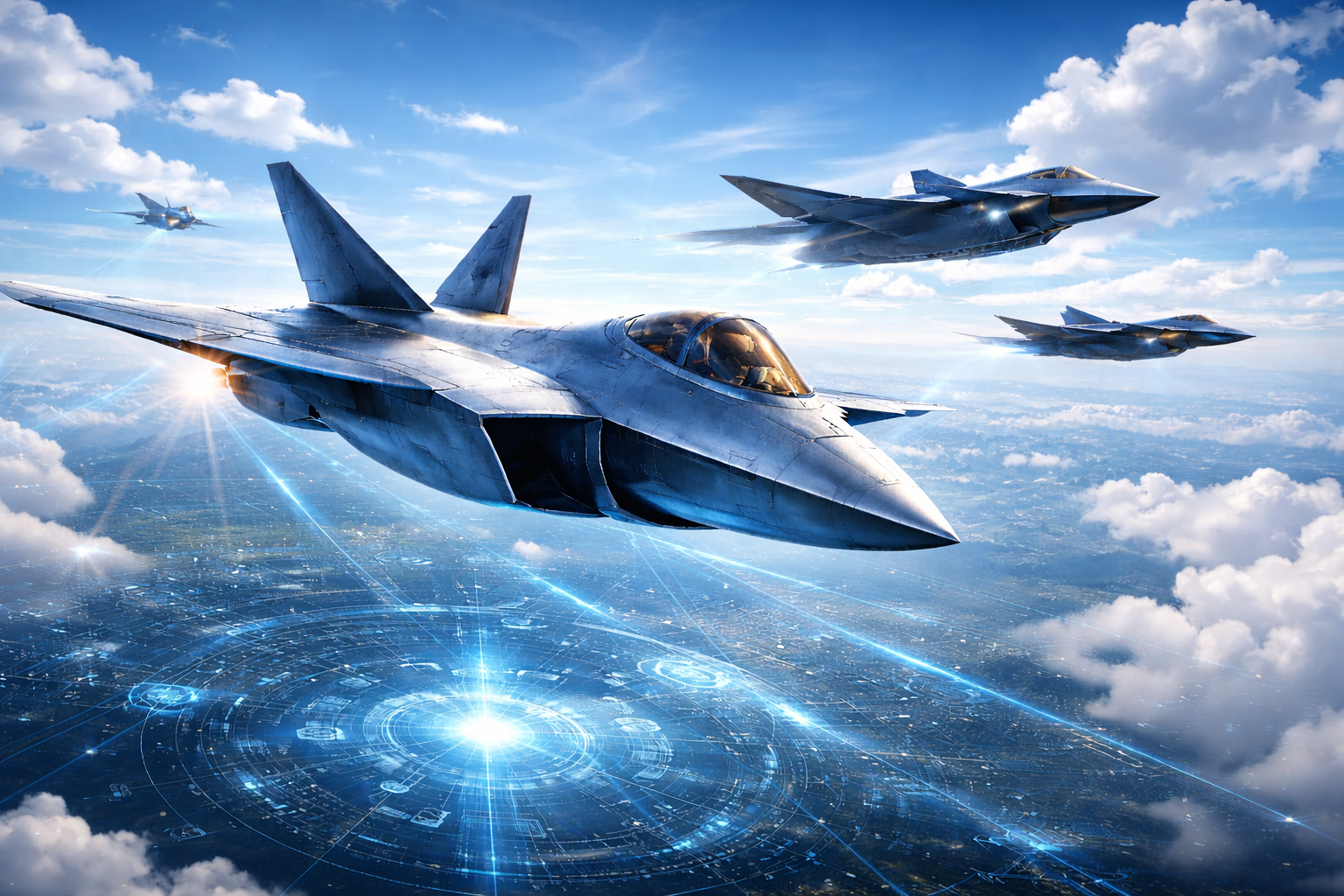
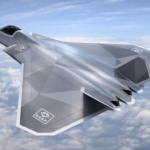
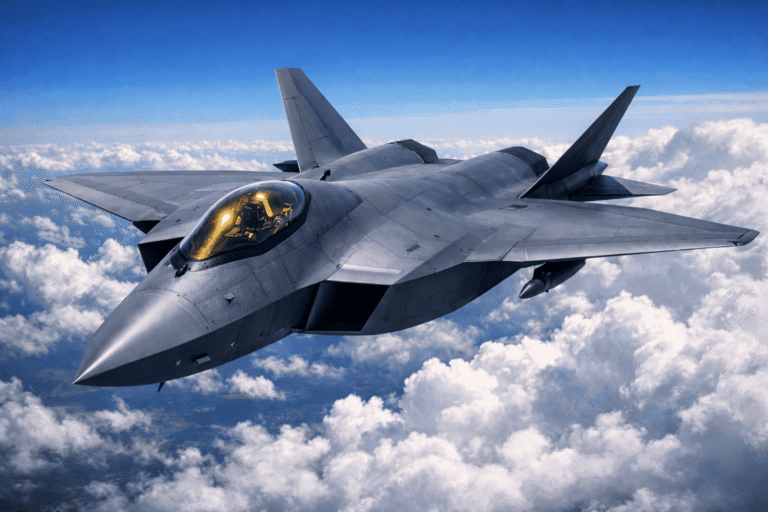
Concept illustration of next-generation fighter aircraft representing the future of 6th generation fighter jets and advanced air combat technologies.
Sixth Generation Fighter Jets
Modern military aviation is moving into a new step and at the center of this change are the 6th generation fighter jets technology. These new fighter jets technology are not just better versions of older planes, they bring a big change in how air fights will happen in the future. Countries developing these jets want to be far ahead in technology by using advanced sensors, artificial intelligence, drones that work together, and fast connections..
Earlier fighter jets mainly focused on speed, stealth, or turning ability, but 6th generation jets are designed as smart combat systems. They are made not only to defeat enemy planes but also to control the whole battlefield by managing information, making decisions, and coordinating actions in air, land, sea, space, and cyber areas.
This article will explain what 6th generation fighter jets are, how they are different from older jets, which countries are making them, and why they will be important for the future of air fights..
What means of 6th Generation Fighter Jets?
6th generation fighter jets are the next generation fighter jet in military aviation. They are expected to replace or work with current fifth generation jets in the 2030s and later. Instead, of this technology, they combine many advanced systems to work together smoothly.
These 6th generation fighter jets are built to operate in dangerous areas where give more advantages like speed or stealth and bypass to other fighter jet or track radar systems. They must survive against advanced air defenses, cyber attacks, electronic warfare, and strong enemies stagies.
6th generation jets is that they act as command centers. They can coordinate drones, share real time data fastly, and make fast decisions using AI integration system
6th generation fighter jets are designed to operate in highly environments where traditional advantages like speed or stealth alone are no longer sufficient.
Key Technologies Defining 6th Generation Fighter Jets
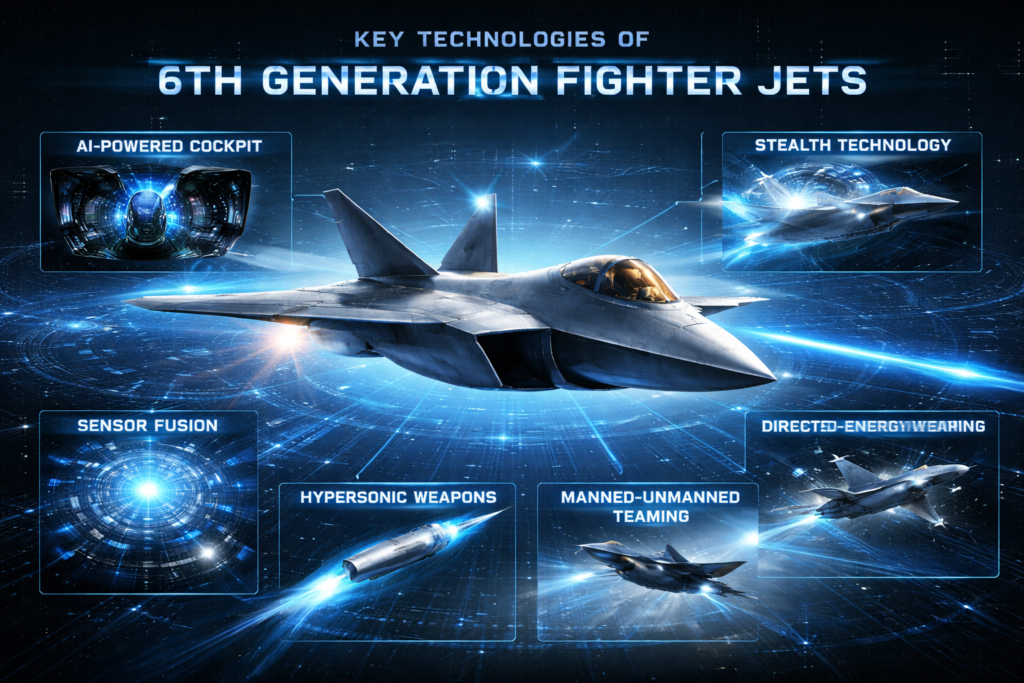
The capabilities of 6th generation fighter jets go far beyond those of previous generations. Several models of technologies set them apart.
Artificial Intelligence and Self making Decision system
Artificial intelligence is main important component of 6th generation fighter jets. AI systems will assist by ai pilots by managing sensors, prioritizing threats, and even recommending or in executing critical decisions. This ai asisted pilot workload and allows faster reactions in complex combat scenarios.
In some mission profiles, sixth generation fighter jet may operate with minimal human input or even fly without a pilot at all and anywhere.
Manned and Unmanned Team system
One of the most and important features of 6th generation fighter jets is that they can control small drones, sometimes called “loyal wingmen.” These are all drones can carry weapons, gather information around, block enemy radar system and jam electronic signals.
Working together with of these all drones makes the fighter jets more stronger and safer. They can reach more areas and carry out missions without putting the pilot in danger situations.
Advanced Stealth and Survivability
While stealth already exists in fifth-generation aircraft, 6th generation fighter jets are expected to feature adaptive stealth. This may include new materials, variable engine signatures, and advanced electronic countermeasures that allow aircraft to adjust their visibility depending on the threat environment.
Survivability for sixth generation fighter aircraft is about more than avoiding radar—it includes cyber resilience, electronic warfare dominance, and resilience against space-based threats.
Next-Generation Sensors and Networking
The sensors of 6th generation fighter jets will do work more than normal radar system. They will combine heat sensors, with very quietly detection systems, electronic signals moving around in the air, and information from satellites into one complete in one display.
This “sensor fusion” in 6th generation fighter jet helps the jet see enemies first, understand what is happening quickly, and take action before the enemy activity. This gives a big advantage in modern air warfare.
What 6th Generation Fighter Jets are deferent from 5th Generation fighter jets
The fifth generation fighter jets like the F-35 and J-20 are highly advanced, but 6th generation fighter jets are represent a qualitative leap rather than a simple improvement and advance then 5th generation fighter jet.
Fifth generation fighters stealth and sensor fusion at the aircraft level. In contrast, 6th generation fighter jets focus on systems of full control and efficiency for warfare, where the aircraft acts as a node in a much larger combat networks.
Another major difference is adaptability. sixth generation fighter aircraft are being developing with open architectures, allowing rapid software upgrades and with ai integration of new technologies without redesigning the entire aircraft.
Which Countries are Working on 6th Generation Fighter Jets ?
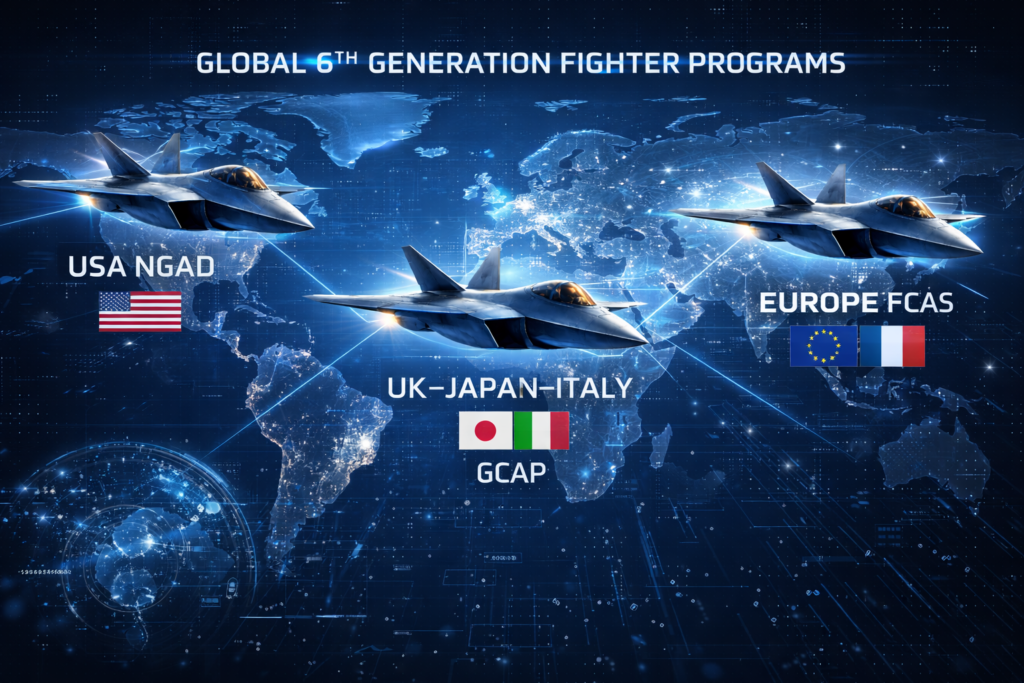
Many countries are investing in 6th generation fighter jets to increase their air warfare strenthen, each pursuing its own approach based on strategic needs.
U.S means United states
The United States is toper in development through programs such as Next Generation Air Dominance (NGAD) in fighter techs. American 6th generation fighter jets are expected to prioritize air superpower, deep petroleum missions, and seamless integration with unmanned systems.
The U.S. vision emphasizes flexibility, allowing 6th generation fighter jets to adapt quickly to emerging threats.
United Kingdom, Japan, and Italy
The Global Combat Air Programme (GCAP) is a joint effort by the UK, Japan, and Italy. Their approach to 6th generation fighter jets focuses on multinational interoperability, advanced sensors, and digital design processes.
This collaboration aims to produce 6th generation fighter jets that can operate effectively alongside allied forces.
France, Germany, and Spain
The Future Combat Air System (FCAS) is Europe’s flagship project for 6th generation fighter jets. It emphasizes networked warfare, manned-unmanned teaming, and deep integration with European defense systems.
FCAS views 6th generation fighter jets as part of a broader combat ecosystem rather than standalone platforms.
China and Others
While official details are limited, China is widely believed to be researching sixth generation fighter aircraft with a strong focus on artificial intelligence and long-range operations. Other countries are also exploring technologies that may contribute to future sixth-generation designs.
Expected Roles of 6th Generation Fighter Jets
The mission profile of 6th generation fighter jets is far broader than that of earlier fighters.
- Air superiority in heavily defended airspace
- Command and control of unmanned combat systems
- Long-range strike and penetration missions
- Electronic warfare and cyber operations
- Integration with space and missile defense systems
By performing these roles simultaneously, sixth generation fighter aircraft redefine what a fighter aircraft can do.
Why 6th Generation Fighter Jets Matter
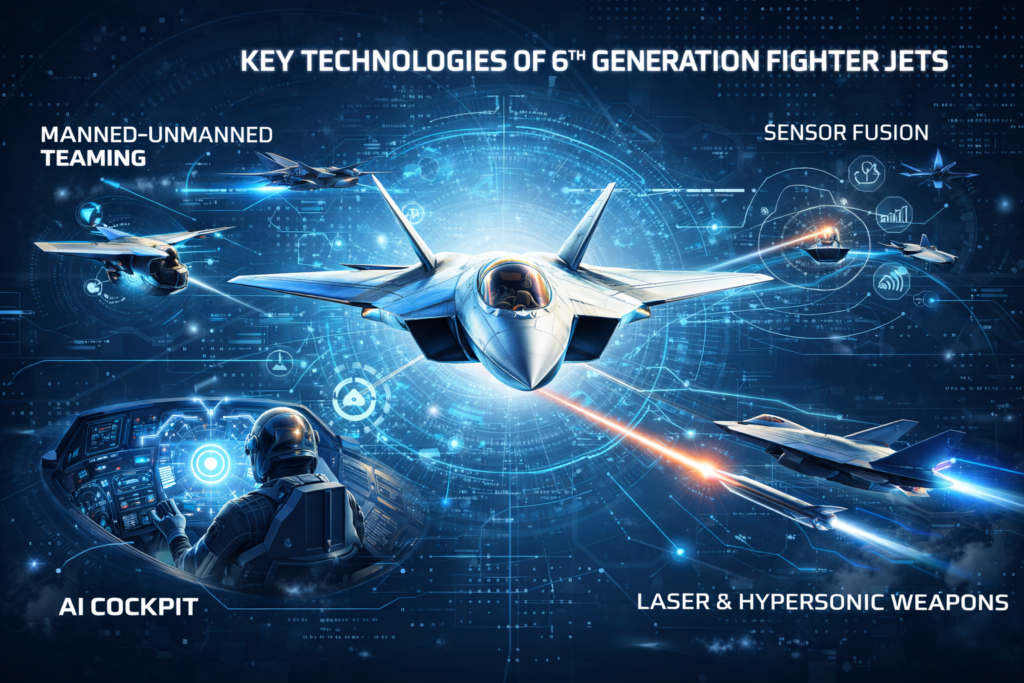
The strategic importance of 6th generation fighter jets lies in their ability to dominate future conflicts before they fully develop. Control of the air increasingly means control of information, networks, and decision-making speed.
Nations that successfully deploy 6th generation fighter jets gain a decisive advantage by shaping the battlefield rather than reacting to it. This capability can deter conflicts, reassure allies, and shift global power balances.
Challenges in Developing 6th Generation Fighter Jets
Despite their promise, 6th generation fighter jets face significant challenges. Development costs are extremely high, and integrating advanced AI and networking systems requires unprecedented levels of testing and security.
Ethical questions also arise, particularly regarding autonomous decision-making in combat. Designers of sixth generation fighter aircraft must balance technological capability with human control and accountability.
When Will 6th Generation Fighter Jets Enter Service?
Most experts expect sixth generation fighter aircraft to begin entering service in the mid-to-late 2030s. Initial deployments will likely be limited, with capabilities expanding over time through software updates and system integration.
Rather than replacing existing fleets overnight, sixth generation fighter aircraft will operate alongside fifth-generation aircraft for many years.
The Future of 6th Generation Air Combat
The rise of sixth generation fighter aircraft marks a turning point in military aviation. Air combat is no longer just about dogfighting or radar evasion—it is about data dominance, intelligent systems, and coordinated action across multiple domains.
As technology evolves, sixth generation fighter aircraft will continue to adapt, ensuring their relevance in an increasingly complex security environment.
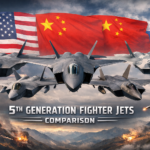
Before read the future of air combat, it is important to understand the about on which these advancements are built. Modern air forces today depend heavily on 5th generation fighter jets, which introduced stealth, sensor fusion, and network high level technology for warfare as core combat principles.
Conclusion
6th generation fighter jets in peresent but makting the air power for future air warefare .. By combining artificial intelligence researchs, unmanned assists , advanced sensors, and adaptive stealth, they go far beyond anything seen in previous generations.
sixth generation fighter are designed to control information arounding , shape the battlefield, and deliver decisive advantages before an enemy can respond. As development continues, these aircraft will become the cornerstone of global air superiority for decades to come.
About the Author

2 thoughts on “6th Generation Fighter Jets List Explained Clearly”